
Hunter's Point
Written by Elizabeth Gjelten
Directed by Christine Young
Original Music by Pat Moran and Eula Janeen Wyatt
Featuring: Carlos Aguirre, Allison Payne, Christine Rodgers and Eula Janeen Wyatt
Attending a performance of Hunter’s Point at St. Boniface Church Theater, in the heart of the Tenderloin, is a complicated experience. It’s a play with music about the strong ties of family, loss, the divisive effects of mental illness, and about new love blooming like roses in bombed-out Sarajevo. But underneath those gracefully waltzing themes lies the pavement of the play: finding a home, and what that means for each of us.
Although the play isn’t about the Hunters Point in our neighborhood, it touches on issues, such as the current state of the Hunters Point Shipyard cleanup, that affect this neighborhood directly. If you have a few dollars and a couple of hours, it might be a welcome and timely diversion.
To enter the church, nighttime theatergoers may need to step around actual homeless people who are trying to sleep outside on the sidewalk. Seeing people who are homeless is unavoidable in this neighborhood, making the church an appropriate place for the play/conversation of Hunter’s Point.
The play’s action centers on Ruthie (played precisely by Christine Rodgers), a cynical, attractive red-haired adventure-travel writer, who is looking for her sister Eva (a very convincing Eula Janeen Wyatt), a singer who lives somewhere outside on San Francisco’s streets. Eva, a fine-boned, fragile blonde, has a mental illness and doesn’t want to take medication, so she’s become estranged from her family through a series of episodes of acute illness and forced hospitalizations. Their mother, Eva’s main caretaker, died years ago, their father has just died, and Ruthie needs to tell Eva the news.
Having run out of ideas, Ruthie makes a lackluster search, then, with no better idea, enlists the help of a beat-box performing genius/street denizen to find her. Carlos Aguirre is spot on as Hunter, a likeable God-fearing performer/con-man who knows all the street people. Ruthie gives Hunter $20, and then jets off to Sarajevo to write an article on post-war tourism.
Eva, meanwhile, sleeps in an abandoned tower at the old Hunters Point Shipyard which awaits redevelopment’s imminent bulldozer. She has ventured out to Hunters Point on her bicycle because she feels safe sleeping there.
Related stat: Public Press recently reported that homeless populations are shifting from inner-city streets to BVHP to avoid violence and evade new laws like Sit Lie.
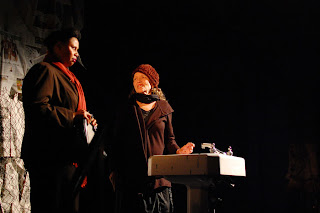
Eva researches psychoactive drug studies during the day at the San Francisco Public Library where she meets overwhelmed librarian, Violet (played convincingly by Allison L. Payne), who tries to help her. Their relationship touches on the issue of the moral treatment of people who have a mental illness. Violet is reaching burnout at her job because she sees so many people who need mental help rather than just books. She’s trained to be a librarian, but spends much of her time managing chronically homeless people who use the library as a sort of home.
Ruthie meets war survivor Zulko (also played by Carlos Aguirre), in Sarajevo, and unexpectedly falls in love. She prolongs her visit, as she and Zulko discuss war, family and the meaning of home, but can’t stop thinking about Eva with whom she has several aborted cell-phone conversations, and dreams about their childhood. She is finally compelled to go back to San Francisco to search again for Eva.
Carlos Aguirre’s mastery of beat box and poetry commands attention. Obviously a seasoned musician and rapper, his acting skills also shine. He has no trouble switching fluidly between the roles of street hustler and war survivor, and this heightens the similarity between those two social positions, peeling back another layer in this onion of a story.
The songs, a mix of traditional spirituals and originals (composed by Wyatt and Pat Moran) are sung by Rodgers and Wyatt a cappella aside from occasional beat box accompaniment. Their two voices blend in a raw, tense way that complements the story’s mood and the sparse sets.
The sets, designed by Nick A. Olivero are simple and effective, with digitally projected photos of San Francisco homeless people by Mark Ellinger (an artist who has himself lived on the streets), lighting by Gabe Maxson, and wonderful sound design by Edna Miroslava Barron that perfectly syncs with the projections.
As well as being a play, Hunter’s Point is intended as a conversation with the community of the Tenderloin about homelessness and how communities can come together and cope with it. The audience is invited to stay after each Saturday performance to participate in that conversation.
The play is about ideas and issues, such as mental illness, homelessness and alienation, which come up naturally within the story, rather than being trotted out for display one at a time. It isn’t preachy, and would be captivating no matter what the setting or circumstances. But using it as a catalyst to inspire change in a desperate neighborhood is brave and effective.
Writer Elizabeth Gjelten and director Christine Young spent the better part of two years writing and obtaining grants to cover the costs of the production.
Hunter’s Point is a typical San Francisco story that unfolds like a pocket map. It has elements that everyone can relate to, the story draws the audience into it, and the story is literally spilling over into the streets.
By Elizabeth Skow, all photos by Gabe Maxson
 The lights in Bayview Hunters Point have dimmed as the community mourns the loss of Eloise Westbrook and Leroy Looper.


